Golf cart dimensions confuse buyers worldwide. Different countries have different rules. This creates problems for manufacturers and customers alike.
Standard golf carts range from 96 inches to 168 inches (2440mm to 4270mm) in length, but exact dimensions vary significantly by seating capacity, manufacturer specifications1, and regional regulations2.

I have spent years working with golf cart dealers across six continents. The lack of universal standards creates real headaches for everyone in this industry. Last year, I visited dealers in the United States, Chile, Australia, Thailand, Saudi Arabia, the United Kingdom, and several African countries. Each location showed me different regulations and customer needs.
How Do Different Seating Configurations Affect Golf Cart Length?
Seating capacity directly impacts cart length. More passengers need more space. This affects both design and regulations in different markets.
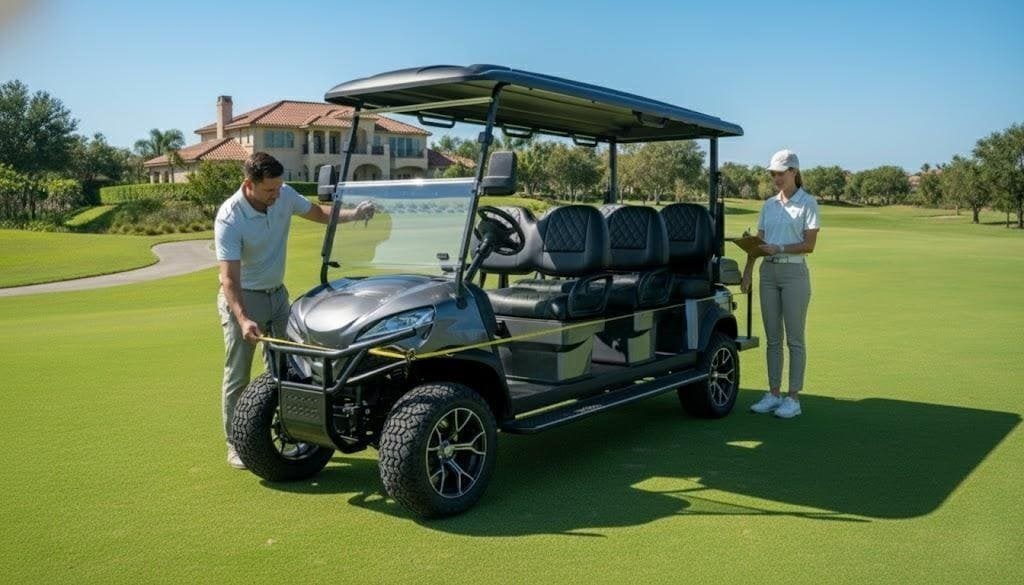
Two-seat golf carts typically measure 96-120 inches (2440-3050mm) long, four-seat models3 range 120-144 inches (3050-3660mm), while six-seat versions4 extend 144-168 inches (3660-4270mm) in total length.
Standard Seating Measurements
Different seating arrangements create distinct size categories. Each configuration serves specific market needs5 and usage patterns.
Two-seat carts represent the most compact option. These models typically measure 96-120 inches (2440-3050mm) in total length. The width stays consistent around 48 inches (1220mm). These carts work well on tight golf course6s and in areas with strict size limits.
Four-seat models add significant length for the rear passenger area. Most measure between 120-144 inches (3050-3660mm) long. The extra seating requires additional wheelbase and body length. These carts dominate the American market where families and groups prefer shared transportation.
Six-seat and eight-seat configurations push length limits in most regions. These models often reach 144-168 inches (3660-4270mm) in total length. Some utility versions7 extend even further for cargo space. However, many countries restrict these longer vehicles from public areas.
| Seating Capacity | Length Range (inches) | Length Range (mm) | Typical Width | Primary Use |
|---|---|---|---|---|
| 2-seat | 96-120 | 2440-3050 | 48" (1220mm) | Golf courses |
| 4-seat | 120-144 | 3050-3660 | 48" (1220mm) | Family/Resort |
| 6-seat | 144-168 | 3660-4270 | 48" (1220mm) | Commercial |
| 8-seat+ | 168+ | 4270+ | 48-60" (1220-1520mm) | Utility/Tour |
What Are the Global Size Standards and Regional Regulations?
Size standards differ dramatically between regions. This inconsistency affects parts availability and service quality. I collected data directly from local traffic departments during my visits.
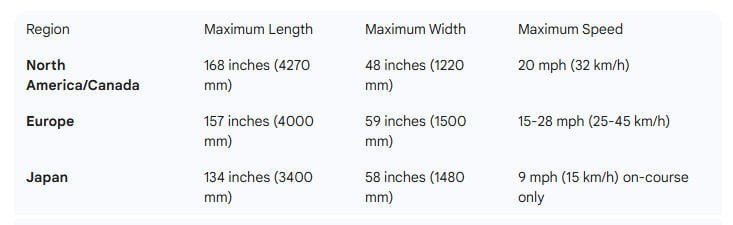
Regional regulations vary significantly: North America allows maximum 168 inches (4270mm) length, Europe permits 157 inches (4000mm), while Japan restricts carts to 134 inches (3400mm) maximum length.
Regional Standards Breakdown
Each country I visited showed me their local regulations. The differences were striking and create real challenges for manufacturers.
In North America and Canada, I got these specifications from local traffic departments:
- Maximum length: 168 inches (4270mm)
- Maximum width: 48 inches (1220mm)
- Maximum speed: 20 mph (32 km/h)
European regulations8 take a different approach. Local governments classify golf carts as light four-wheel vehicles:
- Maximum width: 59 inches (1500mm)
- Maximum length: 157 inches (4000mm)
- Maximum speed: 15-28 mph (25-45 km/h)
Europe has looser width requirements than America. However, European carts face stricter usage rules. Most countries prohibit them on public roads completely.
Japan maintains the strictest standards I encountered. Golf course owners there explained their small vehicle classification system:
- Maximum length: 134 inches (3400mm)
- Maximum width: 58 inches (1480mm)
- Maximum speed: 9 mph (15 km/h) on-course only
These variations create serious problems for global manufacturers. Parts that work in American models might not fit European or Asian versions. Service centers need different inventory for each market.
How Do Major Brands Compare in Their Size Specifications?
Brand variations create compatibility nightmares. Even universal parts often fail to fit across different manufacturers. This problem costs dealers time and money every day.
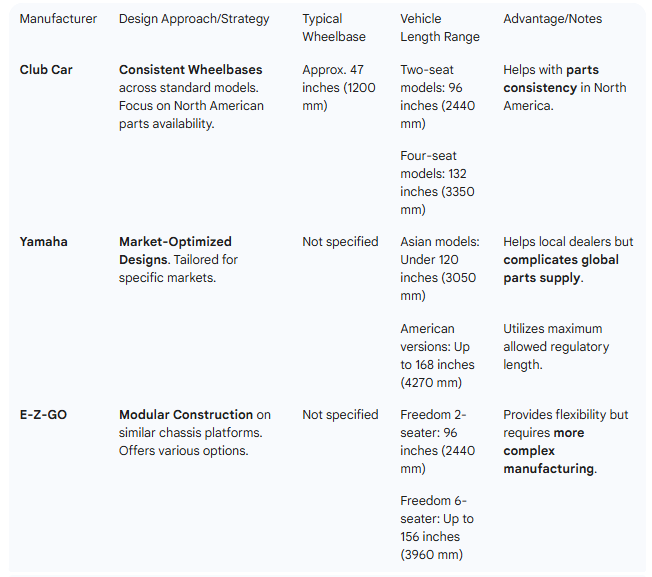
Major golf cart brands vary significantly: Club Car9 ranges 96-144 inches (2440-3660mm), Yamaha10 spans 96-168 inches (2440-4270mm), while E-Z-GO11 measures 96-156 inches (2440-3960mm) depending on model configuration.
Brand-Specific Design Philosophy
The American market dominance creates some standardization. However, problems still exist between major manufacturers even in the same country.
Club Car9 builds their standard models around consistent wheelbases. Most measure approximately 47 inches (1200mm) between axles. This consistency helps with parts availability in North America. Their two-seat models typically measure 96 inches (2440mm) while four-seat versions reach 132 inches (3350mm).
Yamaha10 takes a different approach. They optimize for different markets separately. Their Asian models use compact designs staying under 120 inches (3050mm). American versions stretch to the full 168 inches (4270mm) allowed by regulations. This flexibility helps local dealers but complicates global parts supply.
E-Z-GO11 focuses on modular construction. They offer various length options on similar chassis platforms. Their Freedom series ranges from 96 inches (2440mm) for two-seat models up to 156 inches (3960mm) for six-seat configurations. This approach provides flexibility but requires more complex manufacturing.
The wheelbase standardization works better in America than elsewhere. Most American brands use 47-50 inch (1200-1270mm) wheelbases. Asian markets prefer 40-44 inch (1020-1120mm) wheelbases for compact vehicles. European customers want efficiency over size with 44-48 inch (1120-1220mm) wheelbases being common.
What Regional Differences Drive Size Variations?
Different regions prioritize different features based on local conditions. Climate, terrain, usage patterns, and cultural preferences all influence size requirements significantly.
Regional preferences create distinct size patterns: American markets favor 132-168 inch (3350-4270mm) carts, Asian regions prefer compact 96-120 inch (2440-3050mm) models, while African markets demand extended utility versions7 reaching maximum legal limits.
Market-Driven Size Variations
My dealer visits revealed fascinating regional patterns. Each area has developed unique size preferences based on local conditions and customer needs.
American golf course6s feature wide fairways and long distances between holes. Larger carts carry more equipment and provide better comfort for players. The 168-inch (4270mm) maximum length gets used frequently for four and six-seat models. Resort applications often prefer longer carts for luggage and equipment storage.
Asian markets face significant space constraints. Golf courses have tighter layouts with narrow cart paths. Parking areas limit vehicle size severely. Compact 96-120 inch (2440-3050mm) carts work much better in these environments. Japan's 134-inch (3400mm) limit reflects these practical constraints rather than arbitrary regulations.
European courses balance between American spaciousness and Asian constraints. Their 157-inch (4000mm) maximum allows reasonable size without American excess. However, road use restrictions limit where carts can travel. Most stay on private golf course6 property only.
African applications emphasize utility over pure golf course6 use. Extended cargo areas serve multiple community purposes. These vehicles might reach maximum allowed lengths for practical cargo capacity rather than passenger comfort. Utility models often sacrifice passenger seating for functional storage space.
What Does the Future Hold for Golf Cart Size Standardization?
Standardization remains elusive despite growing global demand. Different markets resist uniform standards due to local needs and infrastructure limitations.
Future golf cart standardization faces significant challenges: regional infrastructure differences, varying usage patterns, and conflicting safety regulations prevent unified global dimensional standards from emerging in the near term.

Standardization Challenges and Opportunities
The golf cart industry struggles with standardization more than most vehicle categories. I see this problem affecting aftermarket support and manufacturing costs daily.
America's large market creates de facto standards for many components. The 47-inch (1200mm) wheelbase appears in most American-designed carts. However, this standard doesn't work well in space-constrained markets like Japan or dense European cities.
Parts compatibility represents the biggest standardization failure. Universal components that should fit multiple brands often require modifications. Battery compartments, seat mounting points, and body panel attachments vary between manufacturers unnecessarily. This increases service costs and complicates inventory management for dealers.
Future standardization might focus on component interfaces rather than overall dimensions. Standardized battery sizes, charging ports, and mounting systems could improve compatibility without forcing uniform cart sizes. This approach would help manufacturers serve diverse regional markets while reducing parts complexity.
Electric vehicle regulations may drive some standardization. As golf carts increasingly use public roads, safety standards become more important. Common lighting systems, braking requirements, and electrical standards could create natural standardization pressure across the industry.
However, regional size preferences will likely persist. Japanese courses cannot accommodate American-sized carts due to physical infrastructure constraints. African utility applications need different configurations than European leisure vehicles. Complete dimensional standardization seems unlikely given these fundamental usage differences.
Conclusion
Golf cart lengths vary from 96-168 inches globally, with regional regulations2 and seating configurations driving significant dimensional differences across markets and manufacturers.
About Shining Vehicle
Shining Vehicle brings over 10 years of golf cart manufacturing experience from our headquarters in China. We provide high-quality, customized golf cart solutions for brand owners, wholesalers, and dealers worldwide. Our production lines include chassis welding, electrophoresis, powder coating, body painting, gasoline engine production, and final assembly. All production lines employ staff with 5+ years experience to ensure consistent product quality.
Our Services
- Products: Complete golf cart solutions from design to delivery
- Customization: Custom colors, logos, and configurations to match your brand
- Certifications: ISO9001, CE, and WMI certified manufacturing processes
Quality Assurance
- Premium Components: Toyota-grade controllers and motors for enhanced durability and stability, plus top-3 global EVE lithium battery cells for longer life and higher safety
- Quality Control: Professional testing equipment ensures precise and thorough inspection
- Factory Inspection: 100% pre-delivery testing guarantees high standards
- Certifications: EPA, LSV, SGS, and DOT approved for global compliance
Manufacturing Capabilities
- High-Quality Production: Clean room assembly and manufacturing processes
- Premium Customization: Durable, compliant products for global brand partners
- Flexible Solutions: Customer-specific customization to enhance market competitiveness
Global Impact
We serve customers worldwide with 60+ countries of export and service experience, providing reliable products and custom solutions that drive business growth and customer trust12.
Learn about the specifications that vary by manufacturer and how they impact performance. ↩
Discover the regulations that affect golf cart sizes in different regions around the world. ↩
Explore the dimensions of four-seat models to understand their suitability for families and groups. ↩
Learn about the dimensions of six-seat versions and their applications in commercial settings. ↩
Explore how local market needs shape the dimensions and features of golf carts. ↩
Understand how the design of golf courses impacts the dimensions and features of golf carts. ↩
Understand the dimensions of utility versions and their practical applications in various settings. ↩
Explore the specific regulations in Europe that affect golf cart dimensions and usage. ↩
Discover the size specifications for Club Car models and how they compare to other brands. ↩
Find out the size specifications for Yamaha golf carts and their market adaptability. ↩
Learn about E-Z-GO's size specifications and how they cater to different market needs. ↩
Understand the role of quality assurance in building customer trust and satisfaction. ↩